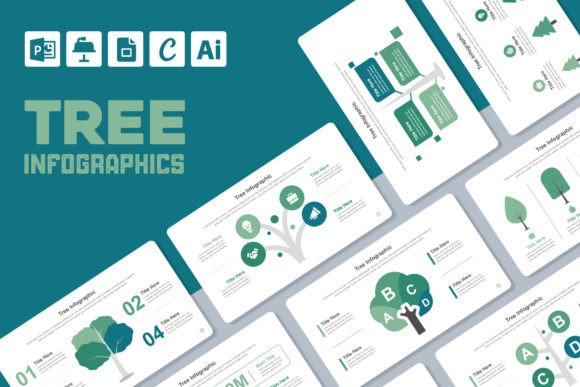
Mastering Data Presentation with Tree Infographic Templates Layout
In an era saturated with information, the ability to communicate complex ideas clearly is no longer just a skill—it is a necessity. Whether you are a business professional outlining a corporate hierarchy, a teacher explaining a biological classification, or a project manager detailing a workflow, the challenge remains the same: how do you make intricate data digestible? The answer often lies in visual storytelling, specifically through the use of a Tree Infographic Templates Layout. This versatile design structure mimics the organic branching of a tree to display relationships, hierarchies, and growth processes, transforming abstract data into a compelling visual narrative.
Understanding the Core Concept of Tree Infographic Templates
A Tree Infographic Templates Layout is a visual framework that utilizes a central trunk and branching elements to represent information. Much like a biological tree, the structure typically begins with a root concept or a starting point (the trunk) and spreads outward into specific categories, sub-categories, or steps (the branches and leaves). This layout is particularly powerful because it taps into a universal symbol of growth and stability.
Unlike linear lists or complex spreadsheets, this layout provides a "big picture" view while allowing for granular details. It helps viewers understand the connection between the core idea and its related components. For instance, in a Tree Infographic Templates Layout, the distance between the trunk and the outer leaves can visually represent the progression of time, the depth of a hierarchy, or the evolution of an idea. This natural flow reduces cognitive load, allowing the audience to process the information without feeling overwhelmed.
Common Challenges in Data Visualization
Many professionals struggle with presenting hierarchical data effectively. Traditional bullet points can feel monotonous and fail to show the relationship between items. Standard pie or bar charts are excellent for numerical data but fall short when trying to explain organizational structures or decision trees. Furthermore, creating custom graphics from scratch requires significant time and advanced design skills, which many subject matter experts do not possess.
The goal for most communicators is to achieve clarity and engagement simultaneously. You want your audience to grasp the structure of your information instantly. This is where the Tree Infographic Templates Layout proves invaluable. It solves the problem of "flat" data by adding depth and dimension, making it easier to highlight primary branches versus secondary details.
How Tree Infographic Templates Address These Needs
The primary benefit of using a Tree Infographic Templates Layout is its inherent logical structure. By organizing data into a hierarchy, you guide the viewer’s eye from the main point to the supporting details in a specific order. This is crucial for storytelling. For example, if you are presenting a company's history, the trunk can represent the founding year, major branches can represent decades, and smaller twigs can represent specific milestones or product launches.
Moreover, these templates are designed for adaptability. Modern templates are not just static images; they are fully editable assets. A high-quality Tree Infographic Templates Layout allows you to adjust colors, resize elements, and swap text effortlessly to match your brand identity. This adaptability ensures that the visual aid enhances your message rather than distracting from it. The branching nature also allows for scalability; you can add more branches if your dataset grows, or trim them down for a high-level executive summary.
Practical Applications and Real-World Scenarios
The versatility of the Tree Infographic Templates Layout makes it applicable across numerous industries and scenarios. Here are a few practical examples of how this layout can be utilized:
- Corporate Hierarchy: HR departments can use this layout to display the organizational structure, showing the CEO at the trunk, Vice Presidents on the main branches, and department heads on the sub-branches. This helps new employees understand reporting lines instantly.
- Product Development: Project managers can map out a product roadmap. The trunk is the core product idea, the main branches are development phases (Design, Prototype, Launch), and the leaves are specific tasks within those phases.
- Educational Content: Teachers can use a Tree Infographic Templates Layout to explain scientific classifications (Kingdom, Phylum, Class, etc.) or historical timelines. The visual metaphor helps students retain information better than text alone.
- Strategic Planning: Businesses can use decision trees to map out potential outcomes of a strategy. The trunk is the initial decision, and the branches represent different choices and their consequences.
By applying the Tree Infographic Templates Layout to these scenarios, you move away from dry data reporting and toward a more engaging form of communication that drives understanding and retention.
Implementation and Useful Considerations
When selecting and implementing a Tree Infographic Templates Layout, it is important to focus on usability and design quality. A cluttered tree diagram can be just as confusing as a spreadsheet. Therefore, look for templates that offer a clean, professional design with ample whitespace. This ensures that the branches do not overlap and the text remains legible.
Compatibility is another critical factor. To ensure a smooth workflow, choose a Tree Infographic Templates Layout that is available in multiple formats. Ideally, you want files that work with common software like PowerPoint, Google Slides, Apple Keynote, and Adobe Illustrator. This flexibility allows you to work in the environment you are most comfortable with and ensures that the final presentation looks consistent across different devices.
Furthermore, consider the font and color palette. A professional template should utilize free, easy-to-read fonts so you don't have to worry about licensing issues. The color scheme should be customizable to align with your presentation's theme. When you download a high-quality Tree Infographic Templates Layout, you often receive documentation and support, which can be helpful if you are new to editing vector graphics or complex slide designs.
Tailoring the Layout to Your Audience
Different users will approach the Tree Infographic Templates Layout differently depending on their audience. If you are presenting to a high-level executive board, you might use a simplified version of the tree with fewer branches and bold, high-impact statistics. The focus here is on the "trunk" and main "branches" to convey the big picture quickly.
Conversely, if you are creating a technical manual or an educational guide, you might utilize a more detailed Tree Infographic Templates Layout with multiple levels of depth. In this case, the outer leaves contain specific data points, definitions, or instructions. The key is to match the complexity of the template to the information needs of your specific audience. By doing so, you ensure that the infographic serves its purpose: to clarify, not complicate.
Conclusion
The Tree Infographic Templates Layout is more than just a design trend; it is a fundamental tool for modern communication. By leveraging the organic structure of a tree, you can present complex hierarchies, processes, and ideas in a way that is intuitive and visually appealing. Whether you are mapping out a corporate strategy, teaching a complex subject, or planning a project, this layout provides the clarity and structure needed to succeed. By choosing a professional, editable template, you empower yourself to turn data into a story that resonates with your audience.